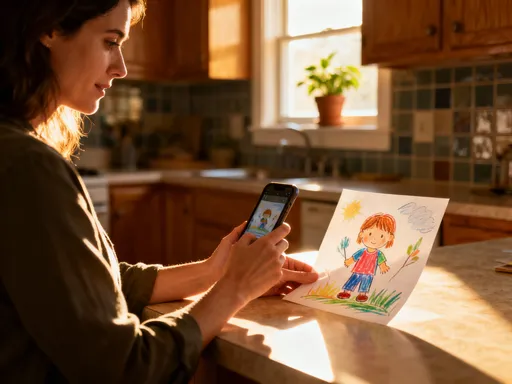
More than photos: How a simple app quietly strengthened my family’s bond
Remember that overflowing photo folder on your phone—hundreds of moments, but hard to share or relive? I felt the same, until I found a better way. It wasn’t about storage or filters; it was about connection. This is the story of how a quiet little app helped me stop just taking photos and start truly keeping them—shared, seen, and cherished by the people who matter most. What began as a simple search for better photo organization turned into something deeper: a way to feel closer to the people I love, even when we’re apart. And honestly, I didn’t see it coming.
The Hidden Problem in Our Pockets
Let’s be real—most of us are drowning in photos. Every birthday, every school play, every messy kitchen moment after baking with the kids. We snap, we save, we move on. But how often do those photos actually get seen? Really seen? Not just scrolled past in a text thread, but paused over, smiled at, remembered? I used to think I was doing enough by sending a few to my mom or saving them in folders labeled “Summer 2023” that I’d never open again. But then I visited my parents last year, and my mom pulled out an old photo album—real paper, real glue, real dog-eared corners. She pointed to a picture of me at age six, covered in cake, and said, “I looked at this just last week.” That hit me. I have thousands more photos than she ever did, but she lived in hers. Mine were just… stored.
It made me wonder: when did we trade memory-keeping for memory-collecting? We’re capturing life more than ever, thanks to smartphones, but the way we handle those images often keeps us further apart. My sister lives across the country, my in-laws are retired in a quieter town, and my nieces and nephews are growing up fast. I’d send a photo here and there, but it felt random—like tossing notes into the wind. There was no rhythm, no shared space. And the truth is, the people I wanted to connect with most—especially the older ones—weren’t scrolling through my Instagram or opening complex email attachments. They wanted something simple. Something warm. Something theirs.
That’s when I realized the problem wasn’t the number of photos. It was the lack of a real home for them. We had tools for capturing, storing, even editing—but not for sharing meaningfully. The photos weren’t bringing us together. They were just… waiting. And in that waiting, something precious was slipping away: the feeling of being part of the same story.
Why Choosing the Right App Felt Overwhelming
So I started looking. Surely, there had to be an app that made this easier, right? I mean, we can order groceries, track our steps, and video-call halfway across the world with one tap. How hard could photo sharing really be? I downloaded a few. Then a few more. Some looked sleek but asked for permissions that made me nervous. Others promised “unlimited storage” but buried the family-sharing feature three menus deep. One even tried to sell me printed books before I’d even uploaded a single image. I felt like I was shopping for a car when all I needed was a bicycle.
And it wasn’t just about features. It was about feeling. I wanted something that didn’t make my mom feel like she needed a tech manual just to see her grandkids’ first snowman. I wanted my sister to be able to jump in without syncing five devices or remembering a second password. I didn’t need AI-generated art or social feeds—I needed warmth. Safety. Simplicity. But every app seemed to be designed for influencers or photographers, not for families who just wanted to stay close.
I even asked around. My friend Lisa told me she used a popular cloud service, but her mom kept “accidentally” deleting shared albums. Another friend swore by a niche app, but it didn’t work on older phones. I started to wonder if I was asking too much. Was it really too much to want a space where everyone—no matter their age or tech comfort—could just be together through photos? The irony wasn’t lost on me: technology meant to connect us was making me feel more alone in my search.
That’s when I paused. Maybe the problem wasn’t the apps. Maybe it was me trying to solve a human need with a tech-first mindset. I wasn’t looking for the most advanced tool. I was looking for the one that felt right. And that meant starting over—not with features, but with feelings.
What I Actually Needed (Not What Tech Ads Promised)
I sat down with a notebook—yes, an actual notebook—and wrote down what I really wanted. Not “500GB storage” or “AI tagging.” Instead, I listed things like: “My aunt should be able to open it without calling me for help.” “I want to add a voice note to a photo of my son’s first bike ride.” “My dad should feel like he’s part of the moments, even if he’s not there.” These weren’t specs. They were hopes.
And that list changed everything. I stopped comparing megapixels and started asking: does this help us feel closer? Does it make sharing joyful, not just efficient? I realized I didn’t need flashy tools—I needed thoughtful ones. I needed private sharing, so my kids’ photos stayed within the family. I needed easy navigation, so my 78-year-old father could scroll without frustration. I needed a way to add captions, dates, even little stories—because a photo of my daughter laughing in the sprinklers isn’t just a moment. It’s “the day she finally stopped being scared of water,” and that story matters.
I also realized how much I valued rhythm. Not just one-off sharing, but something that became part of our lives. Something that reminded us to connect, not just when something big happened, but in the quiet moments too. The morning coffee with the dog. The pancake disaster on a Saturday. Those are the moments that build a family’s emotional glue. I didn’t want an app that treated photos like data. I wanted one that treated them like love letters.
When I shifted my focus from “what does it do?” to “how does it make us feel?”, the noise faded. I wasn’t looking for the most powerful app. I was looking for the one that would disappear—so the people and the moments could shine.
The Moment Everything Clicked
It happened on a rainy Sunday. My kids had built a blanket fort in the living room, and we’d spent the afternoon making homemade pizza. Flour was everywhere. My youngest had tomato sauce in her hair. It was messy, loud, and absolutely perfect. I took a few photos—not with the thought of posting them anywhere, but just because I didn’t want to forget how the light fell through the window, how my son kept sneaking cheese when he thought I wasn’t looking.
Later that night, I uploaded the pictures to the app I’d finally settled on. I tapped a few names—my parents, my sister, my in-laws—and hit share. Then, on a whim, I recorded a short voice note: “This is what joy looks like in our house today. Listen closely—you can hear the dog begging under the table.” I didn’t think much of it. I went to bed.
The next morning, my phone buzzed. It was a message from my aunt—my dad’s sister, who lives three states away and rarely leaves her town these days. She wrote: “I just listened to your voice note. I felt like I was right there, sitting on your couch. I haven’t smiled this big all week.” I read it and cried. Not because it was profound, but because it was so simple. She hadn’t just seen the photo. She’d felt the moment. And I hadn’t had to do anything complicated to make that happen.
That was the turning point. It wasn’t the app’s design or speed that won me over. It was the way it made space for love. For presence. For the quiet understanding that even when we’re miles apart, we’re still sharing life. I realized then that technology doesn’t have to be loud to be powerful. Sometimes, the most meaningful tools are the ones that work softly, in the background, helping us do what we’ve always wanted to do—stay close.
How We Use It Without Even Trying
The beauty of this app is that it doesn’t ask much of us. I set it up once—connected our family group, adjusted privacy so only approved people can see or add photos, and turned on auto-backup from my phone. That was it. Now, when I take a photo, it quietly appears in our shared space. No extra steps. No reminders. No guilt.
But the real magic is in the little features that feel human. I can add a caption like “First time he rode his bike without training wheels!” and tag my parents. My sister loves adding voice notes—she once recorded her toddler singing a made-up song, and my mom played it three times in a row. There’s a “memories” section that gently surfaces old photos on the same date, so last week, we all got a surprise photo from two years ago of my son in a dinosaur costume on a school trip. It sparked a whole group text full of laughter.
Even my dad, who once thought “the cloud” was something in the sky, uses it now. I showed him once—how to open the app, how to tap a photo, how to listen to a voice note. That was enough. Now he scrolls through updates every evening with his tea. He doesn’t post much, but he sees everything. And sometimes, he leaves a heart. That heart means more than any comment ever could.
We don’t use it for everything. It’s not for every selfie or every grocery receipt. It’s reserved for the moments that feel like they belong to all of us. And because it’s so easy, we actually use it. There’s no pressure, no performance. Just real life, shared with real people who care.
The Unexpected Ripple Effects
I thought this was just about photos. I was wrong. Slowly, something deeper started to happen. My kids began asking, “Will Grandma see this?” before showing me a drawing or a new dance move. That simple question told me they’re starting to think of family as a circle, not a collection of separate homes. They’re growing up with the quiet understanding that their lives are part of a bigger story—one that includes people who love them, even when they’re not around.
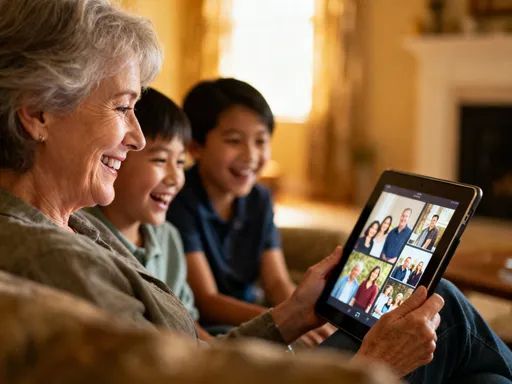
My in-laws, who used to feel a little left out since they moved farther away, now feel involved. My mother-in-law told me, “It’s like getting a little visit every time I open the app.” She sees the school plays, the holidays, the ordinary Tuesdays. And she feels seen too—when we add her birthday photos or record her telling a favorite family recipe, she lights up. It’s not just about receiving. It’s about belonging.
Even communication between siblings has changed. My sister and I used to only call when something big came up. Now, we comment on photos, share updates, react to voice notes. It’s lighter, more frequent, and somehow more meaningful. We’re not just updating each other—we’re being with each other, in small ways that add up.
And then there’s the history. My niece asked me last month, “Who’s that baby in the striped onesie?” It was her older cousin, ten years ago. I told her the story—how he cried through his first haircut but then smiled when he got ice cream. She listened like it was a fairy tale. That’s when it hit me: we’re not just sharing photos. We’re passing down a sense of who we are. These images are becoming heirlooms, not in a dusty box, but alive, shared, and full of voice and laughter.
Why This Matters More Than We Think
In a world that feels increasingly fast and fragmented, holding on to what matters is its own kind of courage. We can’t stop time. We can’t keep our kids little or our parents young. But we can choose to pay attention. We can choose to share. And we can use the tools we have—not to distract us, but to deepen us.
This app didn’t change my life because it’s revolutionary. It changed my life because it’s reliable. Because it shows up. Because it helps me love my family in a way that feels true. It’s not about the technology, really. It’s about what the technology makes possible: a quiet, steady stream of connection that says, “I see you. I remember this. You’re part of this.”
There’s something sacred in that. In knowing that the people you love don’t have to be in the same room to be part of the same moment. In knowing that a simple photo, paired with a voice, a caption, a shared laugh, can become a thread that ties generations together.
I used to think I was just looking for a better way to store photos. Now I know I was looking for a better way to love. And sometimes, the smallest tools help us do the biggest things. So if you’re sitting there with a phone full of photos no one’s seen, I’ll say this: it’s not too late. Start small. Pick one moment. Share it with someone who matters. Let them feel it. Let them in. Because connection isn’t built in grand gestures. It’s built in the quiet, consistent choice to say, “This moment? It’s yours too.”